
Chandra Kumar
Founder — WiselyWise & Smart Maya AI · AI Keynote Speaker · Singapore
The invitation made sense. That was what made it easy to click.
Someone had reached out about an advisory board seat. The message made a plausible connection between my experience building technology and the kind of perspective an organisation might want around the table. There was a link to review the opportunity and arrange a conversation.
I clicked before I had independently verified the invitation. I didn’t submit any information or download anything. Still, I’d answered one question too quickly because I’d already answered another. I could see why a board might want someone with my experience. I hadn’t checked whether this board had actually invited me.
I still don’t know who was behind the message or what they intended. What stayed with me was how little the invitation had to invent. My experience was real. The role sounded plausible. Those two things did much of the work.
When the invitation fits
I spend a lot of time thinking about how leaders make decisions about technology. Early in those conversations, people often tell you a story that hangs together. A vendor understands the problem. A proposed project fits the strategy. A potential partner has done their homework. Those are good reasons to keep listening. Each still leaves a different question unanswered.
This time, I was the one listening to a story that hung together. An advisory role sounded like a place where I could contribute. The invitation let me imagine the work before I had asked who was offering it.
An adviser is often brought into a room to ask a question everyone else has moved past. The question I’d ask in that room was the one I’d skipped at my desk: What can we verify independently?
How do you verify a suspicious advisory board invitation?
Contact the organisation through a channel you find independently, such as its published switchboard or an established contact. Ask two things: Does the advisory board exist? Did you authorise this invitation? Then ask who sponsors the work and what the role entails. You can do all of that without following the original link.
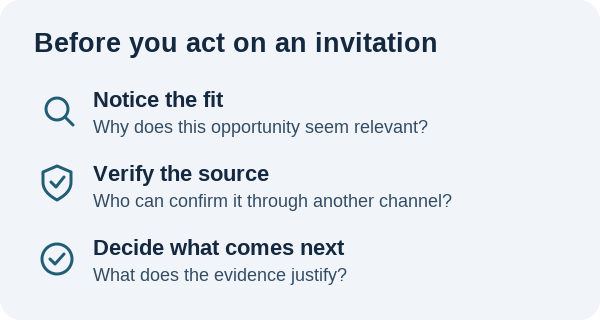
I’d use the same approach for a speaking invitation. There may be a real event and a real organiser. You still want to know whether the person contacting you is authorised to represent either. If you’re the one sending an invitation, make that easy. Give the recipient a way to verify your role and the opportunity through a channel they can find on their own.
What if you already clicked?
I reviewed recent account activity, active sessions, inbox rules and forwarding. Those checks are useful because they focus on signs someone might have gained access or changed how mail is handled. I also cleared cached browser and network data as housekeeping. A cache clear cannot secure an account or tell you whether a device was affected.
- Opened the link only? Close the page and don’t revisit it. Open your accounts through their official sites. Review sign-ins, active sessions, recovery methods, and email rules and forwarding. Check that two-step verification is enabled.
- Entered a password or code, or approved a prompt? Use the provider’s recovery process from a trusted device. Change any exposed or reused passwords, and follow the provider’s steps to remove unfamiliar access and end sessions.
- Ran a download or granted remote access? Disconnect the affected device and contact IT or qualified support. If you shared payment details, call your bank using a number you obtain independently.
Report suspicious content where it originated. If it arrived as a platform notification, check whether you can report the underlying message directly. In Singapore, ScamShield offers ways to check and report suspected scams. Platform reporting guidance · Account recovery guidance · Singapore ScamShield
The question I’d bring into the room
When I speak with leadership teams about AI and digital transformation, a version of this question keeps coming up. What would we need to see before we act? For a proposed AI project, it might be a test using the work people actually do. For a partnership, it might be a reference we can contact independently. For an unexpected invitation, it may be one phone call.
I would still welcome a conversation about an advisory role that fits my experience. The next time an invitation arrives, I know which conversation I want to have first.
Discuss an advisory engagement
If your leadership team is weighing an AI or digital transformation decision and would value an outside perspective, I’d welcome a conversation.
Contact me about advisory work
Planning an event? Explore my speaking topics.
Found this useful?
Share it with your network or follow for weekly AI insights.
More from the Blog
Speakers: Please Check This Before Accepting an International Invitation
A speaking inquiry led me to a warning about invitations naming New Temple Church and RISE BEYOND 2027. Here are the checks I recommend before accepting an international speaking engagement.
ReadClaude Fable 5 and Mythos 5: Why the Future of AI Is Not Just More Power, But More Control
Anthropic's Claude Fable 5 and Mythos 5 point to the next phase of enterprise AI: not simply stronger models, but controlled access, AI governance, and human accountability.
Read