TLDR
What leaders should take away
- Claude Fable 5 and Mythos 5 signal a shift from simple model access to trust-based AI capability.
- The enterprise question is no longer only which AI model is strongest, but who should use which capability, for what work, and under what controls.
- Good AI governance should speed adoption by giving teams clear rules, data boundaries, review paths, and human accountability.
Claude Fable 5 and Mythos 5: more power, more control
Chandra Kumar
Founder — WiselyWise & SmartMaya AI · AI Keynote Speaker · Singapore
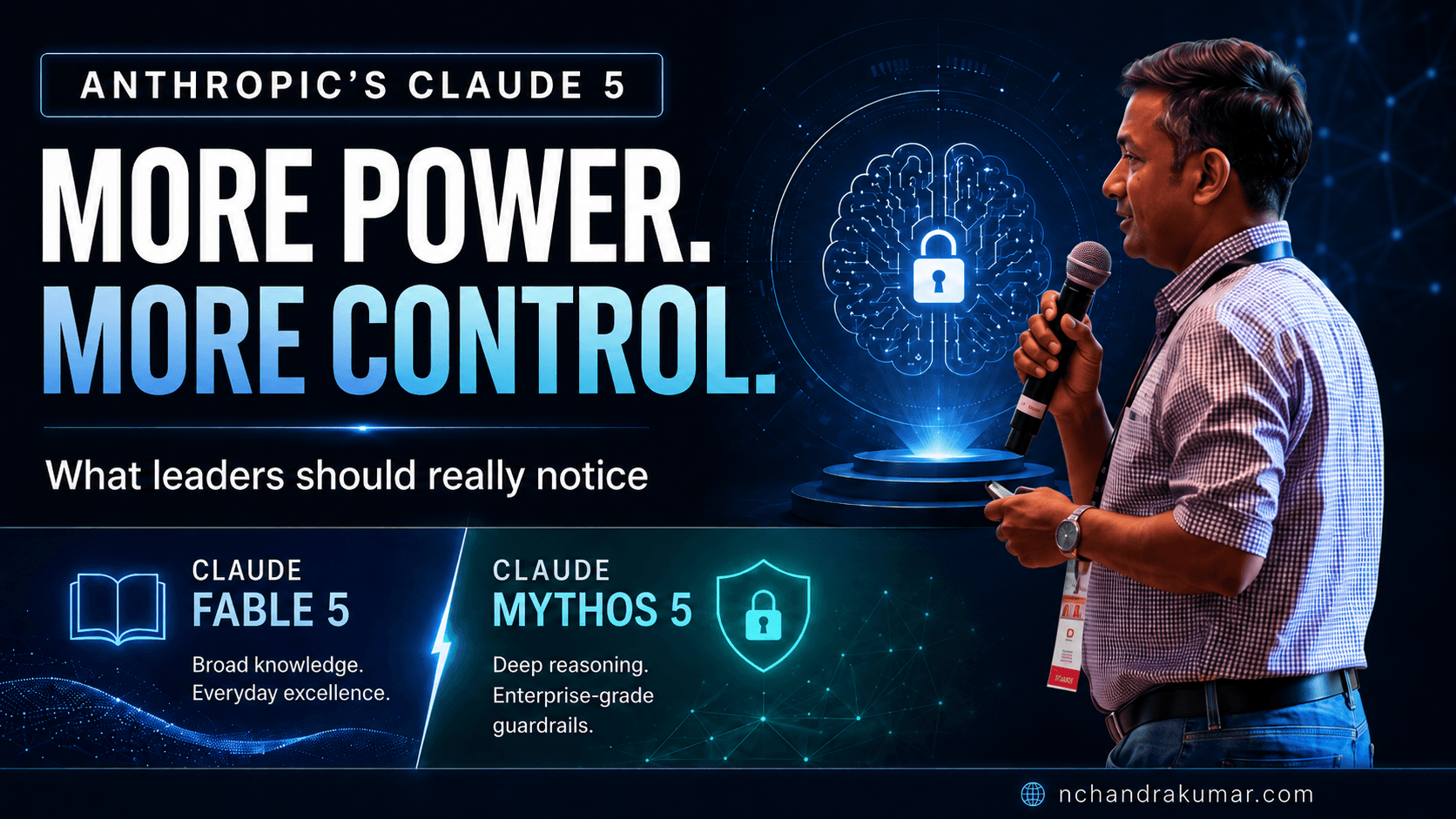
Anthropic's Claude Fable 5 and Claude Mythos 5 are not just another AI model launch. They are a signal of where enterprise AI is heading next: more capability, but also more control.
Most headlines will focus on power. Stronger reasoning. Better coding. More useful vision. Longer autonomous work. Frontier-level cybersecurity capability. Those details matter, but for leadership teams, boards, and conference audiences, they are not the whole story.
The more important question is not simply: which AI model is most powerful?
The better question is: how do we give people access to AI capability in a way that is useful, safe, governed, and accountable?
That is why this release matters for business leaders, not just technical teams.
What Happened With Claude Fable 5 and Mythos 5?
According to coverage from The Verge, Wired, and Axios, Claude Fable 5 is the broadly available version of Anthropic's new Mythos-class model. Claude Mythos 5, based on the same direction of capability, remains limited to selected trusted partners and cyberdefenders through controlled access.
In simple terms: the story is not just that the model is powerful. The story is that access to the most sensitive capability is being differentiated by trust, use case, and risk.
That distinction is worth paying attention to because it mirrors the challenge every organisation now faces internally.
The Real Signal: Controlled Access to Capability
For the past two years, many AI conversations inside companies have started with a tools question.
Should we use ChatGPT, Claude, Gemini, Copilot, or another platform?
That is the wrong starting point.
The better starting point is work design. What work are we trying to improve? What data is involved? What could go wrong if the AI output is incorrect? Who reviews the output? Which decisions require human approval? Which teams need advanced capability, and which teams need safer defaults?
The Fable 5 and Mythos 5 distinction makes this visible. Not every user gets the same level of capability. Access depends on purpose, context, trust, and risk.
That is exactly how enterprise AI adoption will need to work inside real organisations.
Why Business Leaders Should Care
Most companies are still in the early stage of AI adoption. Employees are experimenting. Teams are testing productivity use cases. Leaders are asking whether AI belongs in sales, marketing, operations, HR, finance, customer service, software development, or learning.
But many organisations have not yet answered the harder governance questions:
- Who is allowed to use AI for what kind of work?
- What company data can be used with AI tools?
- Where must human review remain mandatory?
- How should AI-generated work be checked?
- What happens when AI gives a confident but wrong answer?
- How do we move fast without losing accountability?
These questions are no longer theoretical. As AI systems become more capable, they become part of the operating model of the business.
That means AI is not just a technology topic. It is a leadership topic.
AI Governance Should Not Mean Slowing Everything Down
When people hear "AI governance," they often imagine bureaucracy: policies, committees, restrictions, and long approval cycles.
That is not what good AI governance should be.
Good governance should make adoption faster because it gives people clarity. Employees should know what they can use AI for, what they should avoid, when they need review, and where the boundaries are. Leaders should know which use cases are low-risk, which are high-risk, and which require stronger controls.
The danger is falling into one of two extremes.
One extreme is uncontrolled experimentation, where everyone uses AI differently with no oversight. The other extreme is paralysis, where the organisation becomes so afraid of risk that it fails to adopt AI meaningfully at all.
The practical path is controlled adoption.
Give teams useful AI capability. Put the right boundaries around it. Train people properly. Keep humans accountable for the work that matters.
The Human-in-Control Principle
As AI becomes more powerful, human judgement becomes more important, not less.
A weak tool can cause inconvenience. A powerful tool can affect customers, reputation, compliance, security, and strategic decisions.
That is why organisations need humans in control of intent, context, approval, and accountability.
AI can analyse information. AI can generate drafts. AI can identify patterns. AI can speed up technical work. AI can support decision-making.
But leaders must decide where human judgement is non-negotiable.
The future of AI adoption will not be about removing human responsibility. It will be about redesigning how humans and AI work together.
What Leaders Should Really Notice
Claude Fable 5 and Mythos 5 should be seen as a useful leadership signal. The next phase of AI will be shaped by three forces:
- Capability: models will keep becoming more powerful.
- Control: access to those capabilities will need to be managed based on trust, risk, and purpose.
- Culture: people inside organisations will need the confidence and judgement to use AI responsibly.
That is the conversation leadership teams should be having now.
Not simply: which AI model is best?
But: how do we build an organisation that can use AI well?
From AI Awareness to AI Readiness
Many organisations have already completed the awareness stage. Their teams know AI is important. They have seen demos. They have tried prompts. They have attended workshops.
But awareness is not readiness.
Readiness means the organisation has clear use cases, trained teams, data boundaries, review processes, and leadership alignment. Readiness means people know when to use AI and when not to. Readiness means AI is no longer treated as a side experiment, but as part of how the organisation works.
This is also why AI conversations at conferences and corporate leadership events need to move beyond tool demonstrations. Audiences need practical judgement, useful frameworks, and a clear understanding of what responsible adoption looks like in real work.
You can see examples of the leadership and AI adoption themes I speak on in my AI speaking topics, past keynotes and events, and media appearances.
FAQ: What Should Organisations Do Next?
What is the biggest lesson from Claude Fable 5 and Mythos 5?
The biggest lesson is that AI maturity is not only about access to stronger models. It is about matching AI capability to the right user, use case, data boundary, and governance model.
Does AI governance slow innovation?
Poor governance can slow innovation. Good governance speeds adoption because people know what is allowed, what is risky, and when human review is required.
What should leaders prioritise first?
Start with high-value use cases, clear data rules, team training, review workflows, and leadership alignment. Buying tools before answering those questions creates avoidable risk.
Where does human judgement still matter?
Human judgement matters wherever decisions affect customers, employees, legal obligations, brand trust, safety, security, or strategy.
Bring This Conversation to Your Leadership Team
The companies that win with AI will not simply be the companies that subscribe to the most advanced tools. They will be the companies that know how to apply AI safely, practically, and confidently in real work.
Planning an AI leadership event, executive briefing, or conference session?
I help leadership teams understand AI beyond the hype: what is changing, what matters, what risks to manage, and how to build practical AI readiness across the organisation.
Book Chandra for an AI keynote → · Explore AI speaking topics →
Found this useful?
Share it with your network or follow for weekly AI insights.
More from the Blog
I Shut Down My Speaker Website for 9 Months. Then I Vibe Coded It Back in Days.
In May 2025 I killed my WordPress speaker site. Maintaining it was a second job I hadn't signed up for. Nine months later, I rebuilt it from scratch using AI — and finished in days what previously took months. Here's what that experience taught me about where AI is actually taking us.
ReadHow Maya AI Transformed Tamil Language Classrooms at TCEF 2025
As a spotlight speaker at the Tamil Curriculum & Enrichment Framework conference, I shared how Maya AI is cutting lesson planning time by 70% and boosting student engagement by 85% for Tamil language educators in Singapore.
Read